
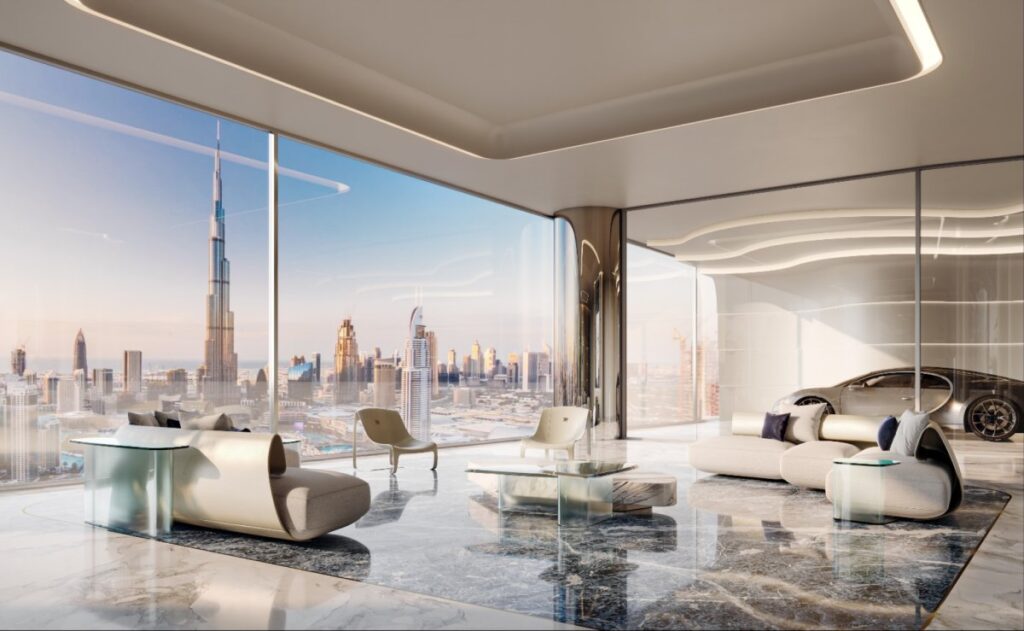
Dubai’s branded residence segment has evolved from a niche luxury category into a core investment asset class. This shift is largely driven by global investors looking for properties that combine lifestyle value with stable rental income.
Within this landscape, The Luxury Collection Residences enters a market already shaped by established names such as Address and St. Regis. However, its positioning is slightly different, relying more on global brand association and hospitality-driven value rather than purely local recognition.
For investors evaluating The Luxury Collection Residences Dubai, the real question is not about branding—it is about performance. Pricing, rental demand, service charges, and long-term appreciation potential are the factors that ultimately determine whether this is a strong investment or an average one.
This guide focuses on those fundamentals, breaking down pricing, ROI, location dynamics, and realistic investment scenarios so decisions can be made based on data rather than marketing language.
Dubai Branded Residences Market: Why It Matters Now
Branded residences in Dubai have consistently traded at a 35% to 60% premium compared to non-branded properties in prime locations since 2023. This premium is supported by several tangible factors.
First, these properties tend to generate stronger short-term rental yields due to their alignment with Dubai’s tourism-driven economy. Second, they offer better resale liquidity, as global buyers often trust recognizable hospitality brands. Third, managed services reduce operational friction, making them attractive for overseas investors.
However, this premium creates a key challenge. Not every branded residence justifies its higher price.
In many cases, projects underperform due to elevated service charges, weak micro-location positioning, or oversupply in certain districts. This is where analyzing The Luxury Collection Residences becomes critical, because the gap between entry price and actual yield determines whether the investment works.
The Luxury Collection Residences Dubai: Price, ROI and Payment Structure
The following figures are based on market-aligned estimates for Dubai’s branded residence segment in the 2025–2026 cycle.
Price Range
Studios are expected to fall between AED 1.4M and AED 1.7M, while one-bedroom units range from AED 2.1M to AED 2.8M. Two-bedroom apartments are likely priced between AED 3.5M and AED 5.2M, with larger units exceeding AED 6M and reaching beyond AED 10M.
On a per square foot basis, pricing is estimated between AED 2,400 and AED 3,200, depending heavily on the final location.
Unit Sizes
Studios typically range from 450 to 650 square feet. One-bedroom units range between 750 and 1,100 square feet, while two-bedroom apartments span approximately 1,200 to 1,800 square feet. Larger units exceed 2,000 square feet.
ROI Expectations
Gross returns are expected to fall between 6.5% and 8.5%, while net returns are more realistically in the range of 4.5% to 6.2%.
The difference between gross and net yield is primarily driven by operating costs, which investors often underestimate.
Service Charges
Service charges are estimated between AED 28 and AED 38 per square foot annually.
For a typical 900 square foot one-bedroom unit, this translates to approximately AED 27,000 per year. This cost alone has a significant impact on net profitability.
Payment Plan
A standard structure would likely include a 10% booking amount, 50% paid during construction, and 40% on handover.
Completion Timeline
If launched as an off-plan project, completion is expected between 2027 and 2028.
Location Analysis: Where This Investment Wins or Fails
Since the exact micro-location is not confirmed, the analysis is based on typical zones where branded residences are developed in Dubai.
These include Downtown Dubai, Business Bay, Palm Jumeirah, and Dubai Marina.
Each of these areas offers different investment dynamics. Properties located near hospitality clusters and tourist hubs benefit from higher short-term rental demand. Walkability, waterfront views, and skyline exposure also play a major role in pricing and occupancy rates.
In Business Bay, rental yields may be strong, but resale performance can be inconsistent. Palm Jumeirah offers strong resale demand but comes with higher entry prices, compressing yield. Downtown Dubai provides a balance but faces intense competition from existing branded inventory.
Ultimately, the location determines whether this becomes a yield-driven investment or an appreciation-driven one. It rarely delivers both at the same time.
Real Investor Scenario
To understand the actual performance, consider a one-bedroom unit purchased at AED 2.4M.
If rented at AED 180,000 annually, the gross yield stands at approximately 7.5%. After deducting service charges of AED 27,000 and management costs of AED 18,000, total expenses reach AED 45,000.
This leaves a net income of AED 135,000, resulting in a net ROI of approximately 5.6%.
This level of return is stable but not exceptional.
The investment becomes more attractive only if short-term rental income pushes annual revenue beyond AED 200,000, or if the property appreciates by 15% to 25% over a three to five-year period.
Comparison with Competing Development
When compared to Address Residences, entry prices are slightly lower and returns are broadly similar, typically in the 5% to 6% range. Address benefits from strong regional brand recognition, which supports resale demand.
St. Regis Residences operate at a higher price point, often exceeding AED 3,000 per square foot. However, yields tend to be lower, usually between 4% and 5%, due to the ultra-luxury positioning.
Six Senses Residences represent an even more premium category, where pricing is significantly higher and yields often fall below 4%. These projects are driven more by exclusivity than by income performance.
The Luxury Collection Residences sits between these categories, offering a balance between yield and brand value, making it more aligned with investor-focused buyers rather than purely lifestyle-driven purchasers.
Who Should Invest and Who Should Not
This project is best suited for overseas investors seeking a managed property with relatively stable income. It also works for buyers focused on short-term rental strategies and for those looking to diversify into branded real estate assets.
It is less suitable for investors targeting high cash flow above 7% net ROI, as well as those with limited budgets. It is also not ideal for short-term flippers unless the entry price is significantly below market value.
Risks and Limitations
One of the primary risks is the impact of service charges, which can significantly reduce net returns.
There is also a growing supply of branded residences in Dubai, which may dilute demand in certain segments. Market timing is another factor, as entering during the later stages of a cycle may limit appreciation potential.
Liquidity should also be considered, as higher-value units typically take longer to sell during slower market conditions.
Strategic Insight: Where the Real Opportunity Lies
The key opportunity is not in the product itself, but in the timing of the purchase.
Investors who enter during the early launch or pre-launch phase and secure units below comparable market pricing position themselves for stronger returns. Targeting a 5% to 10% discount relative to similar projects can significantly improve the investment outcome.
Exit strategy also matters. Selling at handover during peak demand cycles can capture appreciation, while holding for short-term rental income can provide consistent returns.
In simple terms, timing has a greater impact than the asset itself.
FAQs
What is the expected ROI for The Luxury Collection Residences Dubai?
The expected net ROI ranges between 4.5% and 6.2%, depending on whether the unit is used for long-term leasing or short-term rentals, and how operational costs are managed.
Is The Luxury Collection Residences Dubai a good investment?
It is best suited as a moderate-yield, brand-backed investment. It works well for long-term holding and asset appreciation, but it is not ideal for investors targeting high cash flow.
What is the starting price of The Luxury Collection Residences Dubai?
Estimated starting prices are around AED 1.4M for studios and AED 2.1M+ for one-bedroom units, depending on unit size and location within the project.
Can foreign investors buy The Luxury Collection Residences in Dubai?
Yes, foreign investors can purchase with 100% ownership rights in designated freehold areas, which is standard for most branded residence developments in Dubai.
Is short-term rental allowed in this project?
Yes, short-term rental is typically allowed and is often the main strategy used to increase ROI, especially in branded residences linked to hospitality services.
How does it compare to Address or St. Regis Residences?
The project sits between these two in terms of positioning. It offers better yield potential than St. Regis while aiming for broader global appeal compared to Address Residences.
Conclusion: Should You Invest?
The Luxury Collection Residences Dubai is not designed for investors seeking maximum yield. It is better understood as a brand-backed asset offering moderate income with potential for appreciation.
For investors prioritizing stability and long-term positioning, it can make sense. For those focused purely on cash flow, it is unlikely to meet expectations.
The outcome ultimately depends on entry timing. Buying early creates opportunity, buying late results in average performance, and buying purely for yield leads to the wrong investment choice.