
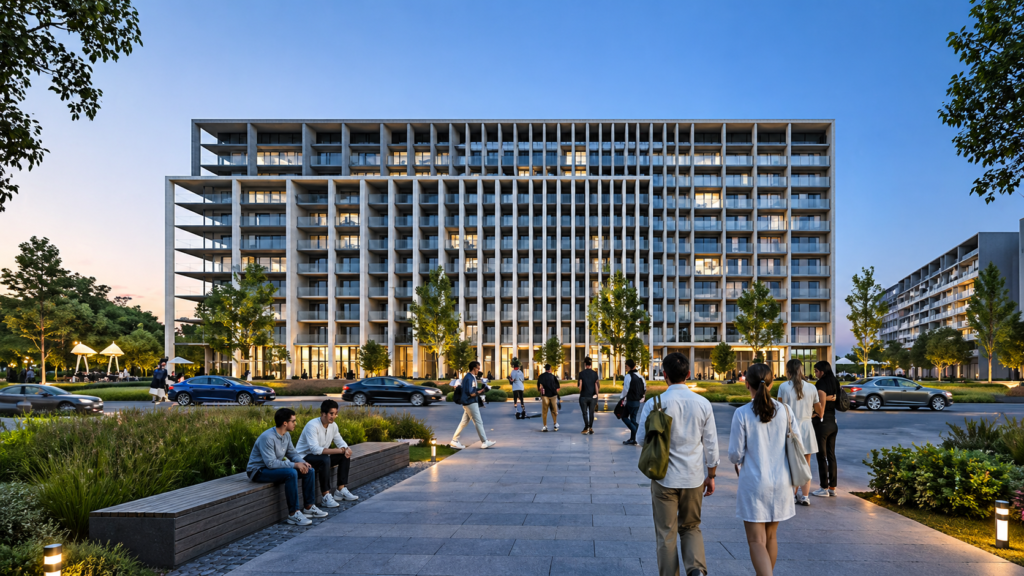
Jenna 1 is a residential project developed by Nshama in Dubai, positioned within the affordable-to-mid segment of the market.
For investors, the appeal lies in entry-level pricing and steady rental demand. The real question is whether the project can deliver meaningful real estate ROI Dubai performance or simply track average market returns.
What current pricing trends reveal about this segment
Dubai’s mid-income housing segment continues to show consistent demand, but price growth has slowed compared to luxury zones.
Communities like Town Square Dubai have seen stable price appreciation of around 4–6% annually, while rental yields remain relatively strong between 6% and 8%.
This indicates a market driven more by income stability than speculative appreciation.
How Jenna 1 pricing compares to surrounding supply
Jenna 1 units typically trade between AED 750 and AED 950 per sq. ft., placing them below citywide averages.
This lower entry price improves yield potential but also signals limited premium positioning. Investors are essentially buying into affordability rather than scarcity.
Transaction costs, including DLD fees and service charges, increase total investment by approximately 6–7%, which directly impacts effective ROI.
Rental yield vs actual cash flow after expenses
Rental income for one-bedroom units averages between AED 45,000 and AED 60,000 annually.
At a purchase price of roughly AED 700,000 to AED 850,000, gross rental yields range from 6.5% to 8%. After accounting for service charges and vacancy, net yield typically compresses to 5.8%–6.5%.
This makes the project competitive for income-focused investors but not exceptional.
Tenant demand strength and long-term sustainability
Town Square’s appeal lies in affordability, community infrastructure, and accessibility to key highways.
Tenant demand is consistent, particularly among families and mid-income professionals. However, ongoing supply launches in similar price brackets limit rental growth acceleration.
For investors, occupancy risk is low, but rental upside remains capped.
Real investor scenario with practical assumptions
Assume a purchase price of AED 800,000 with annual rental income of AED 55,000.
After deducting AED 10,000 in service charges and accounting for minor vacancy, net income falls to approximately AED 43,000.
This results in a net yield near 5.4%, with total return reaching 9%–10% when combined with moderate capital appreciation.
How it performs against competing developments
Projects from Emaar Properties offer stronger appreciation potential but require significantly higher capital entry.
Meanwhile, similar units within Town Square may provide slightly higher yields if acquired at lower resale prices.
Jenna 1 sits in a balanced position, offering stability rather than outperforming either yield or appreciation benchmarks.
Who should realistically consider this project
This investment is suited for buyers prioritizing steady rental income over aggressive growth.
End-users benefit from affordability and community living, while investors gain predictable cash flow with manageable risk exposure.
Key risks that affect return expectations
The primary risk is supply saturation within the affordable segment, which limits both rental escalation and resale appreciation.
Additionally, lower entry pricing often translates to slower capital growth compared to premium zones, reducing long-term upside potential.
Strategic takeaway for portfolio allocation
Jenna 1 functions best as a defensive asset within a diversified portfolio.
It provides stable income and relatively low volatility but lacks the catalysts required for high-growth returns. Investors should treat it as an income-generating holding rather than a capital appreciation play.
Final verdict
Jenna 1 is fairly priced and delivers consistent rental yield within Dubai’s mid-market segment.
It is a suitable investment for income-focused strategies but does not offer strong upside for investors seeking above-market ROI or rapid price appreciation.
FAQs
• Is Jenna 1 a good property investment in Dubai?
It offers stable rental income with moderate appreciation potential.
Best suited for long-term, income-focused investors.
• What rental yield can be expected from Jenna 1?
Gross yields range between 6.5% and 8% annually.
Net returns typically fall closer to 6% after expenses.
• Is Jenna 1 overpriced compared to similar projects?
No, it is priced competitively within the affordable segment.
However, pricing reflects limited premium positioning.
• What type of tenants does this project attract?
Mainly families and mid-income professionals seeking affordability.
Demand is stable due to community infrastructure.
• How does it compare to Emaar projects?
Emaar properties offer stronger appreciation but higher prices.
Jenna 1 focuses on affordability and steady yield.
• What are the main risks for investors?
High supply in the segment limits rental and price growth.
This reduces long-term upside potential.
• Is this project suitable for short-term flipping?
No, appreciation is gradual and not ideal for quick resale.
Returns depend on long-term holding.
• What are the hidden costs involved?
Service charges and maintenance reduce net income.
Initial transaction costs also impact ROI.
• Does the payment plan improve investment returns?
Flexible plans help manage cash flow during purchase.
They do not significantly increase overall ROI.
• Is Jenna 1 better for end-users or investors?
End-users benefit from affordability and community living.
Investors gain stable but moderate returns.