
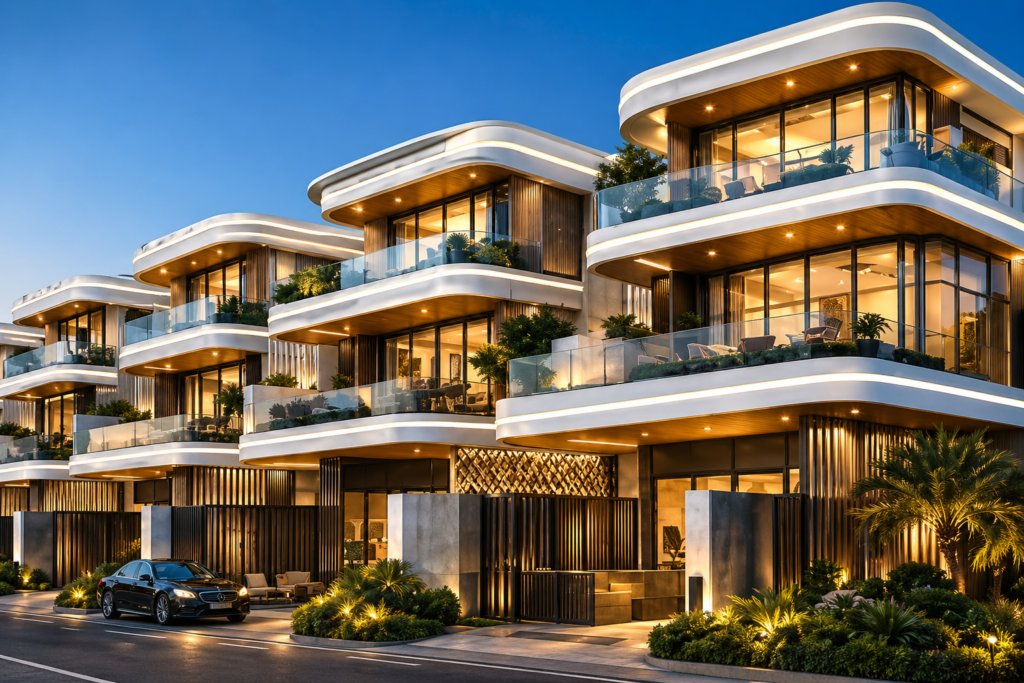
Tilal Binghatti is positioned as a design-led residential project by Binghatti Developers in Dubai, targeting mid-to-premium investors seeking capital appreciation and rental income.
The key question is not branding, but whether the numbers support an investment case in today’s property price Dubai cycle. This analysis focuses on actual pricing benchmarks, rental yield expectations, and risk-adjusted returns.
How the surrounding Dubai market is actually behaving
Dubai’s residential market has entered a late upcycle phase where price growth is slowing but not reversing. Investor demand remains strong, yet yields are compressing in premium segments.
In emerging communities like Jumeirah Village Circle and similar zones, average rental yields range between 6% and 8%, while capital appreciation is stabilizing near 5–7% annually.
This matters because any new launch must outperform these benchmarks to justify entry at current prices.
Where Tilal Binghatti sits on the pricing curve
Tilal Binghatti is typically priced between AED 1,100 to AED 1,400 per sq. ft., depending on unit type and view. This places it slightly above surrounding mid-market inventory but below prime freehold zones.
The pricing reflects design premium and developer branding rather than location scarcity. For investors, this creates a narrow margin for upside unless future demand accelerates.
Additional costs including DLD fees, service charges, and furnishing can increase total acquisition cost by 6–8%, directly impacting net ROI.
Income potential vs real ownership costs
Expected rental income for comparable units ranges between AED 60,000 to AED 85,000 annually for one-bedroom configurations.
At a purchase price of AED 900,000 to AED 1.1M, this translates to a gross rental yield of roughly 6.5% to 7.5%. After service charges and vacancy adjustments, net yield typically falls closer to 5.5% to 6.2%.
This is competitive but not exceptional within Dubai’s broader real estate ROI landscape.
Demand drivers that will actually sustain occupancy
Tenant demand in this segment is driven by affordability relative to central districts and accessibility to business hubs.
Areas like JVC and similar corridors continue to attract young professionals and mid-income residents. However, supply pipeline remains high, which caps rental growth potential.
For investors, stable occupancy is likely, but aggressive rent appreciation should not be assumed.
Real investor scenario: numbers under realistic conditions
Consider an investor purchasing at AED 1M with a 60/40 payment plan.
Annual rental income of AED 70,000 yields 7% gross return. After AED 12,000 service charges and 5% vacancy adjustment, net income drops to ~AED 54,000.
This results in a net yield of approximately 5.4%, with capital appreciation adding another 5% annually under optimistic conditions. Total return potential sits near 10%–11%, but heavily dependent on market stability.
How it compares against nearby alternatives
Projects by developers like Emaar Properties and Sobha Realty often command higher entry prices but deliver stronger long-term appreciation due to location advantages.
In contrast, lower-priced units in the same micro-market may offer slightly higher rental yields due to better entry pricing.
Tilal Binghatti sits in the middle, offering balanced but not dominant performance across yield and appreciation.
Who this investment actually suits
This project aligns with investors seeking moderate risk exposure with stable rental income rather than aggressive capital growth.
End-users benefit from design quality and pricing relative to premium zones, but pure investors must weigh yield compression risks carefully.
Risk factors that cannot be ignored
Supply pressure remains the biggest concern, especially in mid-market communities where multiple launches compete for the same tenant base.
Service charges and maintenance costs can erode returns more than expected. Additionally, resale liquidity may be slower compared to branded master communities.
Market timing is another factor. Entering during a late cycle limits short-term upside and increases reliance on long-term holding.
Strategic interpretation for capital allocation
Tilal Binghatti is not an undervalued entry. It is a fairly priced asset in a competitive segment.
The investment case works only if held for medium to long term, allowing rental income to compound while waiting for appreciation cycles to reset.
Short-term flipping or speculative entry is unlikely to generate strong returns given current pricing.
Final verdict
Tilal Binghatti offers stable but capped returns. It is neither overpriced nor a clear bargain.
Investors prioritizing predictable rental income with moderate appreciation may find it suitable, but those seeking high ROI or rapid capital gains should consider alternative segments with stronger growth catalysts.
FAQs
• Is Tilal Binghatti a good investment in Dubai right now?
It offers stable rental yield but limited short-term appreciation potential.
Best suited for long-term investors, not short-term speculation.
• What rental yield can investors realistically expect?
Gross yields are around 6.5% to 7.5% based on current rents.
Net returns typically settle closer to 5.5% after expenses.
• Is the project overpriced compared to nearby options?
It is slightly premium-priced versus similar units in the area.
The difference comes from branding and design positioning.
• How does it compare with Emaar or Sobha projects?
Those projects offer stronger appreciation due to prime locations.
Tilal Binghatti focuses more on affordability and steady income.
• What is the biggest investment risk here?
Oversupply in the surrounding area can limit rental growth.
This directly impacts yield expansion and resale value.
• Is it suitable for short-term flipping?
No, margins are too tight for quick resale profits.
Returns depend on long-term holding and rental income.
• What type of tenant demand exists?
Mainly mid-income professionals and young residents.
Demand is stable but not aggressively growing.
• How does the payment plan affect ROI?
Flexible plans improve cash flow but don’t increase yield.
ROI still depends on rental income vs total cost.
• What are the hidden costs investors should consider?
Service charges and vacancy periods reduce net returns.
Initial fees can also impact overall investment performance.
• Is this better for end-users or investors?
End-users gain more from lifestyle and pricing balance.
Investors benefit only with long-term holding strategy.