
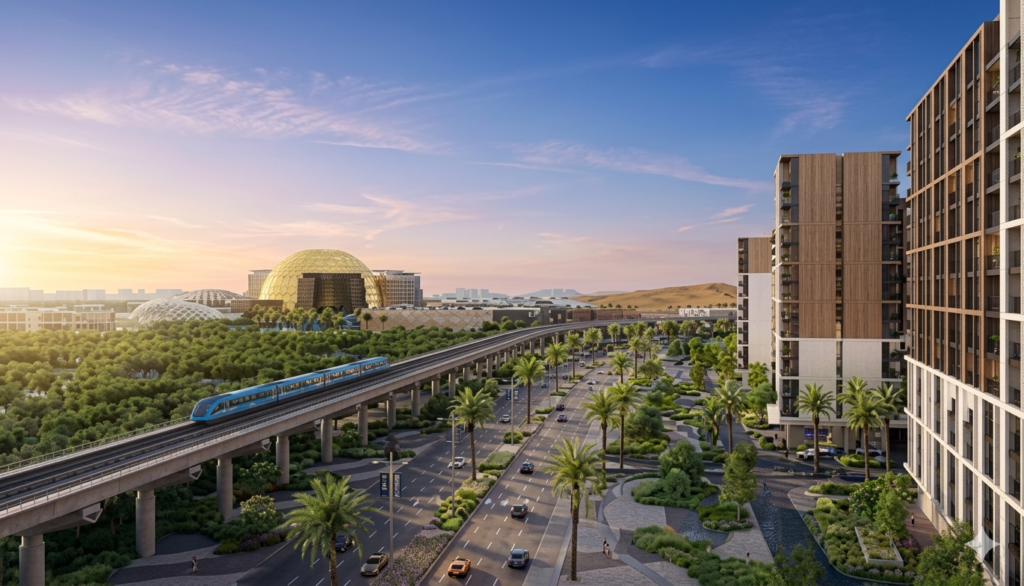
Emaar Properties has positioned Emaar Terra Gardens as a premium villa community targeting capital appreciation rather than immediate rental income. Located in Dubai, the project enters a segment where supply, pricing power, and long-term demand cycles matter more than short-term hype.
For an investor, the key question is not branding—it is whether the numbers justify entry at current price levels and whether the asset can outperform alternative opportunities in Dubai’s real estate market.
How Dubai’s villa segment is actually trending
Dubai’s villa market has been in a sustained upcycle since 2021, driven by end-user migration, tax advantages, and global capital inflow. However, the appreciation curve is now flattening in premium suburban communities.
This matters because Terra Gardens sits in a phase where early investors captured the highest gains. New entrants are effectively betting on continued demand expansion rather than undervaluation.
Where Emaar Terra Gardens sits on the pricing curve
Emaar Terra Gardens is priced in the mid-to-upper tier of suburban villa communities, with average property price Dubai benchmarks ranging between AED 3M to AED 5M depending on configuration.
When adjusted for built-up area and plot size, pricing per square foot is slightly above comparable communities. This premium is largely attributed to Emaar’s brand strength and community planning rather than intrinsic yield performance.
For investors, this signals lower margin of safety at entry.
Income potential vs actual cost structure
Rental income Dubai for similar villa communities typically ranges between 4% to 5% gross yield. After accounting for service charges, vacancy buffers, and maintenance, net rental yield often compresses to 3%–4%.
Assuming a AED 3.5M investment, expected annual rent would fall in the AED 140K–170K range. After costs, realistic net income may sit closer to AED 110K–130K.
This yield profile is significantly lower than apartment assets in emerging districts, which can deliver 6%–8%.
Demand drivers that actually sustain value
Terra Gardens benefits from family-driven demand rather than speculative investor activity. Proximity to emerging infrastructure and lifestyle ecosystems enhances long-term occupancy stability.
However, villa demand is highly sensitive to economic cycles. Unlike apartments, villas have a narrower tenant pool, which can impact liquidity during downturns.
A realistic investor scenario
Consider an investor entering at AED 3.5M with a 50/50 payment plan. During construction, capital is locked without income generation.
Post-handover, assuming 4% gross yield and 5% annual capital appreciation, total return over 5 years may average 6%–7% annually.
This is stable but not aggressive. It positions the asset as a capital preservation play rather than a high-yield investment.
How it compares with competing options
Compared to villa communities in Dubai Hills Estate or Arabian Ranches, Terra Gardens offers newer inventory but at similar or slightly higher pricing.
Established communities provide proven rental performance and resale liquidity. Newer developments rely on future appreciation, which introduces execution risk.
From an ROI perspective, Terra Gardens is not underpriced relative to competitors.
Investor fit: who should actually consider this
This project suits investors prioritizing long-term capital growth and low volatility exposure. It aligns with portfolio diversification strategies where stability outweighs yield.
It is less suitable for investors targeting high rental income or short-term flipping, as entry pricing limits immediate upside.
Risk factors that cannot be ignored
The primary risk lies in oversupply within Dubai’s villa segment. Multiple master-planned communities launching simultaneously could dilute price growth.
Another risk is delayed appreciation. If macro demand slows, premium pricing may take longer to justify, reducing IRR.
Liquidity risk is also higher in villas compared to apartments, especially in early project phases.
Strategic perspective: timing vs positioning
The investment case for Terra Gardens depends heavily on timing. Early-cycle investors benefit from price discovery, while late entrants depend on market momentum.
Current positioning suggests the project is closer to fair value rather than deep discount. This shifts the strategy from aggressive growth to defensive holding.
Final verdict
Emaar Terra Gardens is a fundamentally strong but not high-yield investment. It offers stability, brand-backed execution, and moderate appreciation potential.
However, from a strict ROI lens, it is not the most efficient capital allocation in Dubai’s current market. Investors seeking higher rental yield or faster capital growth may find better opportunities elsewhere.
For conservative investors, it remains a viable long-term asset. For return-maximizers, it lacks a compelling edge.
FAQs
- Is Emaar Terra Gardens a good investment in Dubai?
It is a stable long-term investment but not a high-yield opportunity. ROI depends more on appreciation than rental income. - What rental yield can investors expect from Terra Gardens?
Typical gross rental yield ranges between 4% to 5%. Net yield may fall closer to 3%–4% after expenses. - Is the project overpriced compared to market alternatives?
Pricing is slightly above comparable villa communities. The premium is driven by brand and planning rather than yield. - Does Terra Gardens offer better ROI than apartments?
No, apartments in emerging areas often deliver higher rental yield. Villas focus more on capital appreciation. - What is the expected ROI over 5 years?
Investors can expect around 6%–7% annualized returns combining rental income and appreciation. - Is liquidity a concern for villa investments?
Yes, villas typically have a smaller buyer pool. This can slow resale compared to apartments. - How does location impact investment potential?
The location supports long-term demand but depends on future infrastructure growth. It is not yet a mature rental hub. - What are the biggest risks in this project?
Oversupply, slower appreciation, and lower rental yield are the primary risks investors should consider. - Who should avoid investing in Terra Gardens?
Short-term investors and yield-focused buyers may find better alternatives in Dubai’s apartment market. - Is now the right time to invest in this project?
Entry at current pricing offers limited upside. Timing is more suitable for long-term investors rather than quick gains.